
Be Seen. Be Safe. A Halloween Safety Reminder from Thomson Rogers LLP
October 28, 2026
This Halloween, Thomson Rogers LLP is launching our Be Seen. Be Safe. campaign, with one simple goal: getting every trick-or-treater home safely.
A Saturday Halloween means a busier, longer night
Halloween falls on Saturday, October 31 this year, and that changes the night. With no school or work the next morning, many kids will head out earlier and stay out later than they would on a weeknight.
More adults will also be out at parties and gatherings, so neighbourhood streets will be busier, and for longer, than usual. Halloween won’t land on a Saturday again until 2037, which makes this one of the biggest trick-or-treat nights in years.
Why Halloween is one of the riskiest nights on our roads
Halloween combines excited kids, dark costumes, early darkness and busy streets, and the research shows the risk is real.
What the research found
In 2018, researchers from the University of British Columbia and the University of Toronto published a study in the medical journal JAMA Pediatrics looking at whether Halloween night is more dangerous for pedestrians. They reviewed 42 years of U.S. National Highway Traffic Safety Administration records covering every fatal traffic crash from 1975 to 2016. They then compared the number of pedestrians killed between 5 p.m. and midnight on Halloween with the number killed during the same hours one week before and one week after.
The researchers were concerned that dark costumes, excitement and alcohol from adult Halloween parties might combine to make streets more dangerous. Their findings suggest they do:
- The risk of a pedestrian being killed was 43% higher on Halloween night than on comparable evenings, with about four extra pedestrian deaths on an average Halloween.
- Children aged 4 to 8 faced the greatest danger. Their risk of being killed by a vehicle was 10 times higher on Halloween than on the comparison nights.
- The early evening is the riskiest time. The most dangerous period was 5 to 8 p.m., with deaths peaking around 6 p.m., right when trick-or-treating is in full swing.
- Almost all of the extra deaths were children or young adults.
The study used U.S. data, but the researchers are Canadian, and Canadian streets see the same mix of trick-or-treaters, darkness and traffic. As co-author Dr. Donald Redelmeier of the University of Toronto noted, almost all of these deaths can be avoided with a small change in behaviour.
What Toronto Police have reported
Closer to home, in figures released in October 2015, Toronto Police Service Traffic Services reported that the city typically sees between 138 and 167 collisions a day, but on Halloween that number has climbed as high as 324, an increase of up to 115%. Between 51% and 60% of those Halloween collisions happened between noon and 8 p.m.
More recent Toronto data shows pedestrians remain especially vulnerable. City figures show 39 people died in traffic collisions in Toronto in 2025, and nearly half of them, 19 people, were pedestrians. Toronto Police data for January to May 2026 shows 13 of the 21 traffic deaths were pedestrians, up from 9 during the same period in 2025.
Be Safe. Be Seen. Tips for the trick-or-treaters in your life
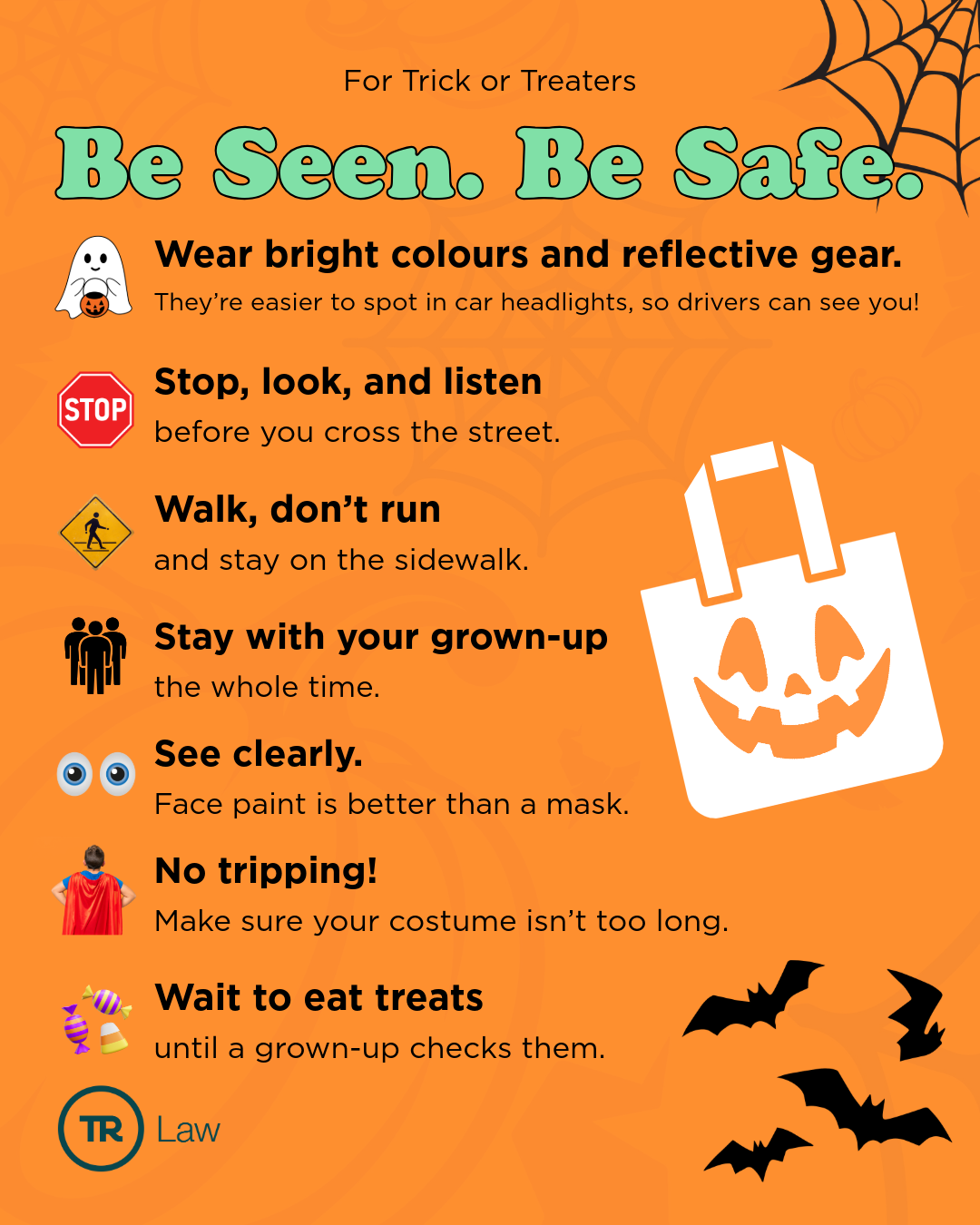
Before heading out, take a few minutes to go over these rules with the kids in your life. They come in two parts: making sure drivers can see you, and making safe choices on the street. Read them aloud together, or print them out for the fridge.
Be Seen
- Wear bright colours. Bright colours are easier to spot in car headlights, so drivers can see you!
- Add reflective tape to the front and back of your costume and treat bag.
- Carry a flashlight or wear glow sticks so you light up the night.
- Stick to well-lit streets and skip dark shortcuts through parks or alleys.
Be Safe
- Stop, look, and listen before you cross the street.
- Cross at corners and crosswalks, never between parked cars.
- Make eye contact with drivers before you step off the curb, so you know they’ve seen you.
- Walk, don’t run, and stay on the sidewalk.
- Stay with your grown-up the whole time.
- See clearly. Face paint is better than a mask.
- No tripping! Make sure your costume isn’t too long.
- Wait to eat treats until a grown-up checks them.
Tips for parents and homeowners
Grown-ups have an important role to play too, whether you’re walking with the kids or handing out treats at the door.
- Head out early while there’s still some daylight, bring a flashlight, and add reflective tape or a reflective bag to dark costumes.
- Make sure there is a clear pathway to your door. Remove all tripping hazards, including garden tools and ornaments, and turn on your porch light.
- Inspect candy before kids eat it. Discard any homemade treats unless you know where they came from, and throw out anything unwrapped or partially unwrapped.
- Going out without an adult? For older kids, agree on a route and a check-in time, and make sure they carry a charged phone, but keep it in their pocket when crossing the street.
Tips for drivers on Halloween night
Keeping kids safe isn’t only up to the kids. If you’re behind the wheel on Saturday, please:
- Slow down in residential neighbourhoods, and be ready to stop at any moment.
- Watch for children crossing mid-block or stepping out from between parked cars. Excited kids don’t always look first.
- Put your phone away and keep your full attention on the road.
- Take extra care when backing out of driveways and pulling away from the curb.
- Avoid residential streets during peak hours if you can, roughly 6 to 9 p.m.
- Plan a sober ride home. If you’re celebrating at a Halloween party, arrange a designated driver, taxi, rideshare or transit before you go.
After Halloween: darker evenings ahead
There’s one more reason to stay alert this year. Daylight saving time ends at 2 a.m. on Sunday, November 1, just hours after trick-or-treating wraps up. Because November 1 falls on a Sunday, this is the earliest the clocks can possibly change.
Halloween night itself will still be on daylight time, but the clock change brings two extra risks. First, the extra hour on Saturday night means some Halloween parties may run later than usual, so plan your safe ride home before you go out. Second, starting the very next day, it gets dark an hour earlier, right when many people are commuting home or walking to and from school and activities.
That shift has a real effect on pedestrians. Toronto Police have noted that the number of pedestrian collisions in the evening doubles in the months after the November time change, and data from Quebec’s auto insurance board found collisions involving pedestrians rose by 78% in the 30 days after the fall time change.
So keep the Be Safe. Be Seen. habits going all season long: wear bright colours and reflective gear when you’re walking after dark, and give pedestrians extra room and attention when you’re driving.
Why this matters to us
At Thomson Rogers, we work every day with people whose lives have been changed in an instant by a collision, including pedestrians struck while simply crossing the street. We see first-hand how one moment on the road can affect a person and their family for years to come.
That’s why road safety matters so much to us, for people on foot and for people behind the wheel. Most of these collisions can be prevented, and the best outcome is the one where no one needs our help at all.
So this Saturday, slow down, look twice, and help the trick-or-treaters in your life light up the night. From all of us at Thomson Rogers: Be Safe. Be Seen. Have a happy Halloween.
If you or someone you love has been injured in a collision, our team is here to help. Contact us for a free consultation.
Sources
- Pedestrian fatalities increase on Halloween, particularly among children, University of British Columbia news release, October 30, 2018
- Pedestrian fatalities increase on Halloween, particularly among children, ScienceDaily (on the JAMA Pediatrics study)
- Traffic fatalities in Toronto reach record low in 2025, TorontoToday.ca (City of Toronto data)
- Are the roads more dangerous after the time change?, The Globe and Mail (Toronto Police pedestrian collision data)
- More people hurt in Quebec road accidents after fall time change, data shows, The Canadian Press, November 2024 (SAAQ data)
Share this


Related articles:
Stay Informed
Subscribe to receive updates on the latest news from Thomson Rogers LLP as well as invitations to seminars, webinars and more.
